Kimi K2: OpenAgentic Intelligence
Kimi K2 is a groundbreaking mixture-of-experts model designed for exceptional performance in frontier knowledge, reasoning, and coding tasks. Built for autonomous action and intelligent problem-solving.
Developed by MoonshotAI, the Kimi K2 family combines a 1T-parameter MoE backbone, 384 experts, 32B active parameters, and recent releases such as Kimi K2.7 Code for long-context software engineering, Kimi Code, tool use, and up to 256K-token workflows.
Kimi K2.7 Code Quick Experience
Try the powerful AI assistant right away
Kimi K2.7 Code is now the latest coding-focused K2 model. Ask me about model IDs, Kimi Code, 256K context, thinking mode, or how it compares with earlier K2 releases.
Leading Performance Across Benchmarks
Kimi K2 achieves state-of-the-art results compared to other leading models across various evaluation benchmarks
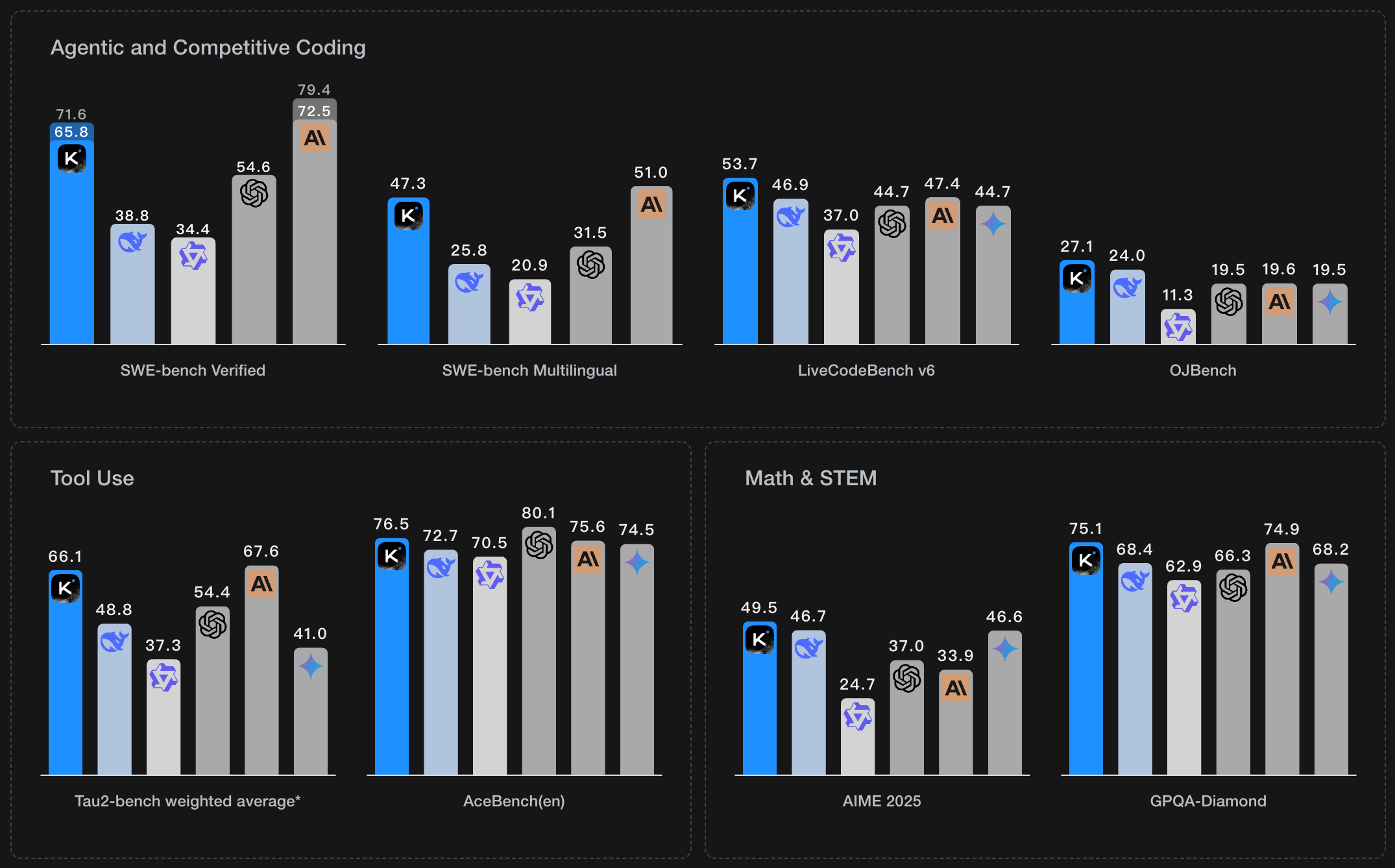
Agentic Capabilities
Autonomous problem-solving with tool interaction
High Performance
State-of-the-art reasoning and coding
Mixture-of-Experts
384 experts with 32B activated params
Recommended paths
Continue with the most-used Kimi K2 guides
Visitors often arrive through a model or language page. These paths keep the next answer one click away.
Kimi K3
Flagship hub: 2.8T specs, 1M context, API id kimi-k3, pricing, and when to switch.
Open guideKimi K2.7 Code
Current release overview, capabilities, and practical context for K2.7 Code.
Open guideKimi Code
Setup paths, API notes, and developer workflow guidance for Kimi Code.
Open guideKimi K3 Status
K3 availability tracker with official Kimi Code model docs and plan notes.
Open guideKey Features of Kimi K2
Discover the innovations that make Kimi K2 exceptional at frontier knowledge, reasoning, and coding tasks.
What is Kimi K2?
Kimi K2 is a groundbreaking mixture-of-experts model that achieves state-of-the-art performance in knowledge, reasoning, math, and coding benchmarks while maintaining efficiency through intelligent routing.
About Kimi K2 Large Language Model
Kimi K2 is an open-source large language model developed by MoonshotAI (Dark Side of the Moon), adopting a Mixture of Experts (MoE) architecture. As a new generation of agentic AI, Kimi K2 has a total parameter scale of 1 trillion, including 384 expert models, with 32 billion parameters activated per inference.
The Kimi K2 family performs strongly in coding, mathematical reasoning, knowledge Q&A, tool use, and agent workflows. Recent releases extend context to 256K tokens for larger codebases, long documents, and complex dialogue scenarios.
Unlike traditional large language models, Kimi K2 has powerful tool calling and agent capabilities, capable of autonomously executing complex tasks and interacting with external tools and APIs to achieve true autonomous problem solving.
Technical Features
- • 1 trillion parameter mixture-of-experts architecture
- • 384 expert models with intelligent routing
- • Up to 256K long-context support in recent K2 models
- • 15.5 trillion token training data
- • Open source commercial license
Application Scenarios
- • Code generation and debugging
- • Mathematical reasoning and computation
- • Long document analysis
- • Intelligent agent application development
- • Multilingual dialogue interaction
Kimi K2 Users Say
Early adopters share their experience with Kimi K2's advanced agentic intelligence capabilities.
"Kimi K2's agentic capabilities are impressive. The model demonstrates sophisticated reasoning and can autonomously solve complex problems that require multiple steps."
"The coding performance is outstanding. Kimi K2 understands context better than any model I've tested and generates production-ready code consistently."
"The mixture-of-experts architecture is brilliantly implemented. It achieves remarkable efficiency while maintaining state-of-the-art performance across benchmarks."
"Kimi K2's tool integration capabilities are game-changing. The model can seamlessly interact with external APIs and perform autonomous actions."
"The move toward 256K context gives coding agents more room for repositories, logs, plans, and long-running reasoning without losing the thread."
"Developing Kimi K2 has been an incredible journey. We're proud to contribute this breakthrough model to the open-source community."
"Kimi K2 represents a significant leap forward in agentic AI. The model's ability to autonomously reason through complex problems and integrate with external tools makes it incredibly powerful for real-world applications. This is the future of AI assistance."
Frequently Asked Questions
Get answers to common questions about Kimi K2's capabilities, technical specifications, and usage.
Need technical support?
Access documentation, community support, and technical resources for Kimi K2.
Open source model available at: HuggingFace • GitHub • API Documentation