Kimi K3 Open Weights July 27: What You Can Use Today
Your timeline is full of “Kimi K3 is open” screenshots. You open Hugging Face, type Kimi-K3, and… nothing that looks like a finished download.
That gap is the whole story right now.
As of July 17, 2026, Moonshot has shipped Kimi K3 in products and on the API. It has not shipped the full public weight dump yet. The company says full model weights land by July 27, 2026. Until then, “open” is a roadmap word—not a folder on your disk.
This site is independent of Moonshot. We’re tracking public docs and posts so you can plan the next ten days without believing every repost.
The short answer (read this first)
- Want K3 quality today? Use kimi.com, Kimi Work, Kimi Code, or the API model id
kimi-k3on platform.kimi.ai. - Want to self-host full K3 weights today? You almost certainly can’t yet—there is no confirmed public checkpoint for K3 the way there is for K2.6 / K2.7 Code.
- Waiting for open weights? Put July 27, 2026 on your calendar as Moonshot’s stated deadline, then verify the real repo/license/README when it appears—don’t treat “by July 27” as “already on HF.”
- Dreaming of a 24GB laptop run? Scale is ~2.8 trillion parameters. Moonshot’s own serving notes point at large multi-accelerator setups, not a consumer GPU party. Plan for API or hosted inference unless you already run cluster-class iron.
If you only needed one sentence: use the API this week; treat open weights as a late-July event you re-check, not a download button you have today.
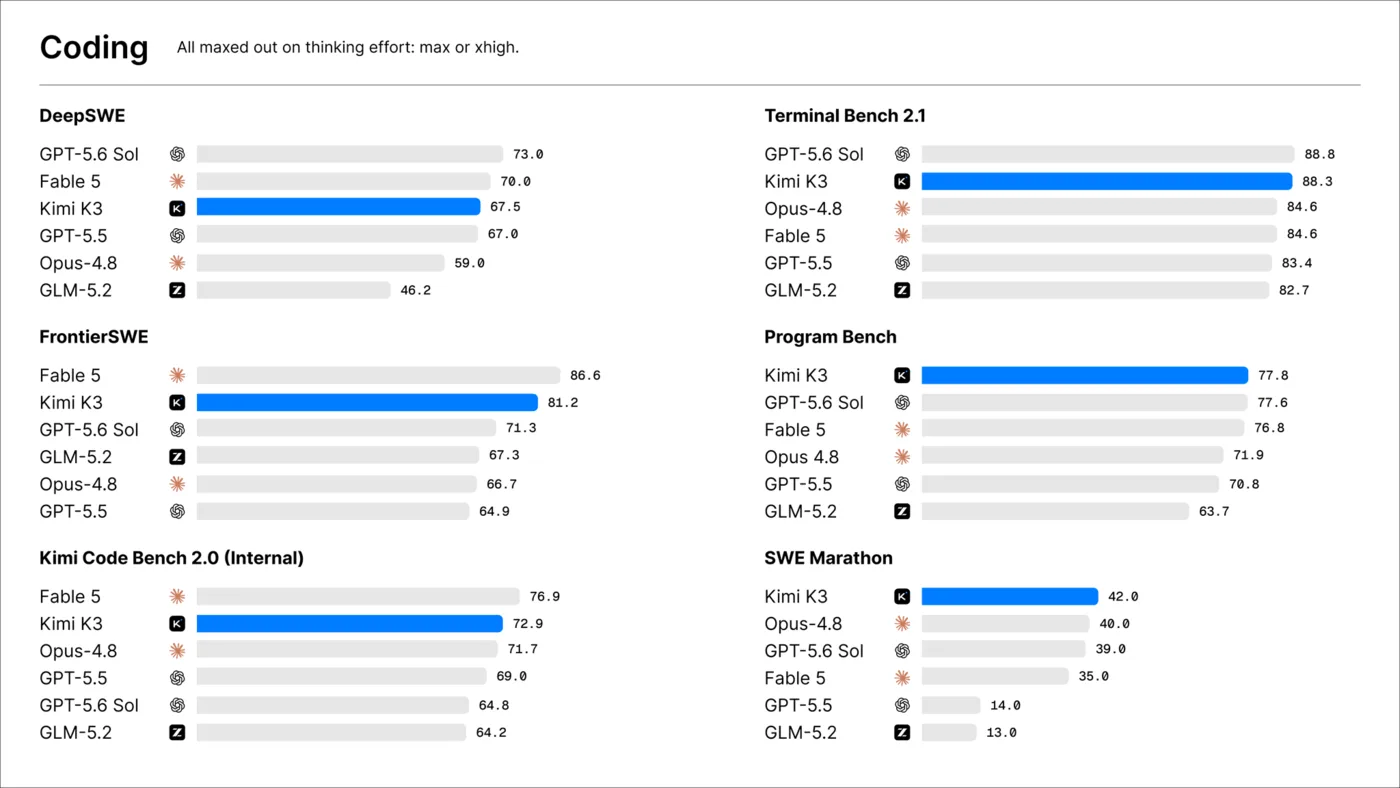
Source: Official @Kimi_Moonshot K3 launch media, July 16, 2026; same charts as the Kimi K3 blog.
What Moonshot has actually said
From Moonshot’s Kimi K3 launch post (July 16, 2026):
| Claim | Status today |
|---|---|
| Product access (Kimi.com, Kimi Work, Kimi Code, API) | Live |
| API model id | kimi-k3 |
| Stated scale | 2.8T parameters, 1M-token context, native vision |
| Thinking at launch | Max effort by default; low/high modes “later” |
| Full model weights | Promised by July 27, 2026 |
| Tech report / deeper training detail | Coming with / around the weight release (their wording) |
| List price (API, USD / 1M tokens) | Cache hit $0.30 · input $3.00 · output $15.00 |
Two extra lines from the same post matter if you care about “can I run this at home”:
- They say they are aligning rollout with inference partners and open-source maintainers—a polite way of saying “weights are not a casual drop; stack support has to land too.”
- On serving, they recommend supernode-style deployment with 64+ accelerators for K3. That is not a gaming-PC footnote. It’s the company telling you this is datacenter-shaped.
So if a YouTube thumbnail says “download K3 free and run it tonight,” ask: download from where? As of this writing, the honest answer is still nowhere public.
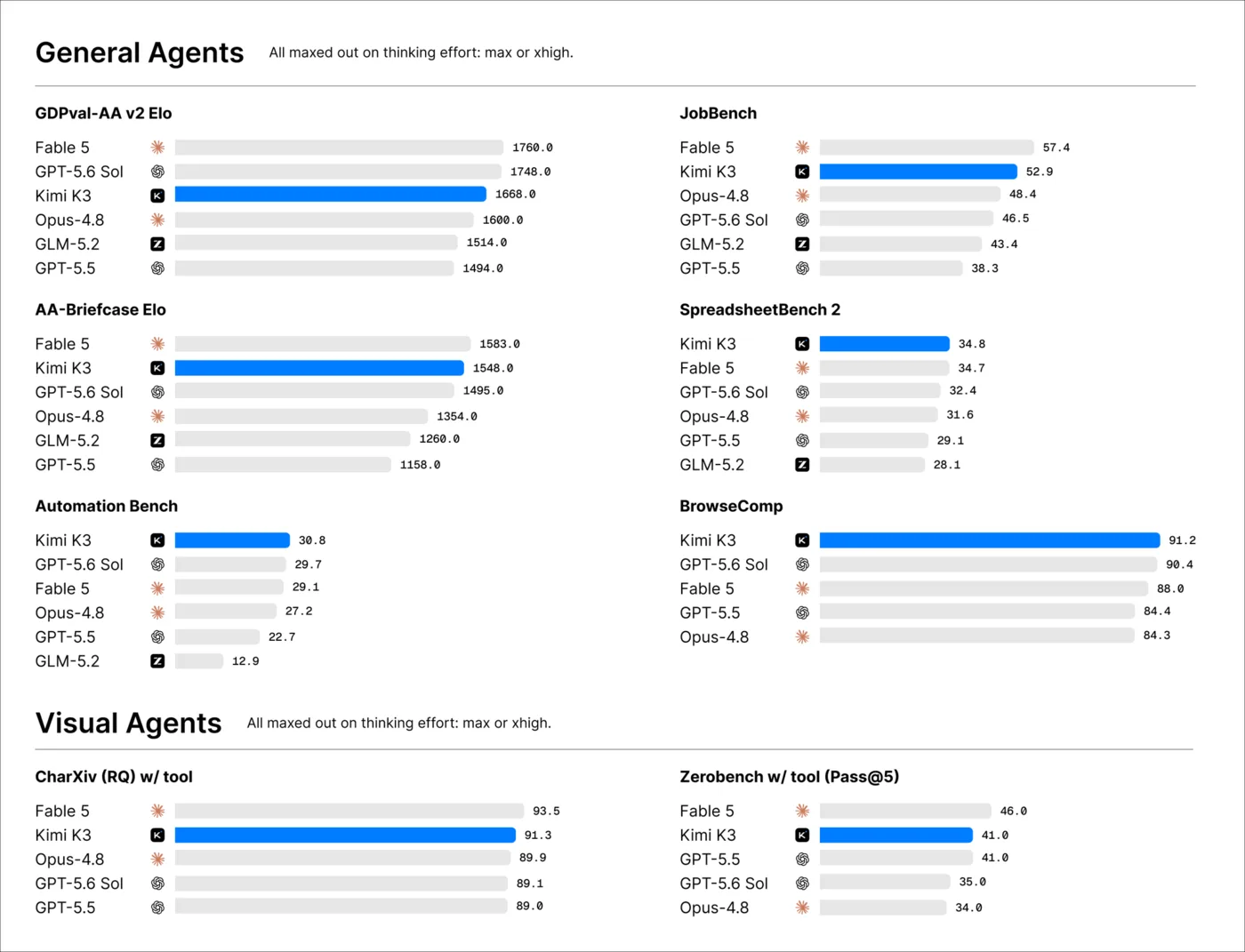
Source: Official @Kimi_Moonshot K3 launch media, July 16, 2026.
“Open” vs “downloadable” (don’t mix them up)
Moonshot is calling K3 the first open 3T-class model. In launch language, that means they intend to publish weights, and they are positioning the architecture at open-model scale.
It does not automatically mean:
- files are already on Hugging Face,
- a specific license file is already published for K3,
- every quant and GGUF you hope for ships on day one,
- or that “open” = free to use for every commercial purpose without reading the license.
For earlier Kimi lines (K2.5 / K2.6 / K2.7 Code), Moonshot has published weights under a Modified MIT style license on Hugging Face. That history is a reasonable prior—not a signed contract for K3 until the K3 repo itself appears. When weights drop, read the LICENSE on that repo, not a tweet about “open source.”
Quick mental model
| Phrase you hear | Safer translation |
|---|---|
| “K3 is open” | Moonshot is selling an open-weight promise + product that is already live |
| “Open weights by July 27” | Deadline-style commitment in the official blog—not a guarantee of your local hardware |
| “Open-source coding model” (about K2.7 Code) | Already a different, smaller coding SKU with public weights |
| “I can fine-tune K3 on my 4090” | Almost certainly fantasy at 2.8T total scale without serious cluster + quantization story |
What you can use today (and what to keep)
You do not need weights to evaluate whether K3 helps your work.
Use K3 now if: the job is hard, long, or multi-modal (big repo + screenshots, long research threads, “keep going for hours” agent work) and you accept premium token cost.
Keep K2.7 Code if: you live in IDE/CLI coding agents and care about day-to-day shipping more than flagship depth. That specialist path still exists for a reason.
Keep K2.6 if: you already have a stable long agent at a lower price band and K3 has not beaten it on your tasks yet.
For a fuller “which model” split, see our K2.6 vs K2.7 Code vs K3 guide and the release-day K3 write-up. Patch those pages mentally with one fact: API is real; full weights are still scheduled.
Cost reality while you “try open intelligence”
Official API list (per 1M tokens): $0.30 cache hit · $3 cache miss · $15 output. Launch thinking is max-only, so short “hello world” prompts can still burn a surprising amount of reasoning tokens. Treat early experiments like a pilot budget, not an unlimited playground.
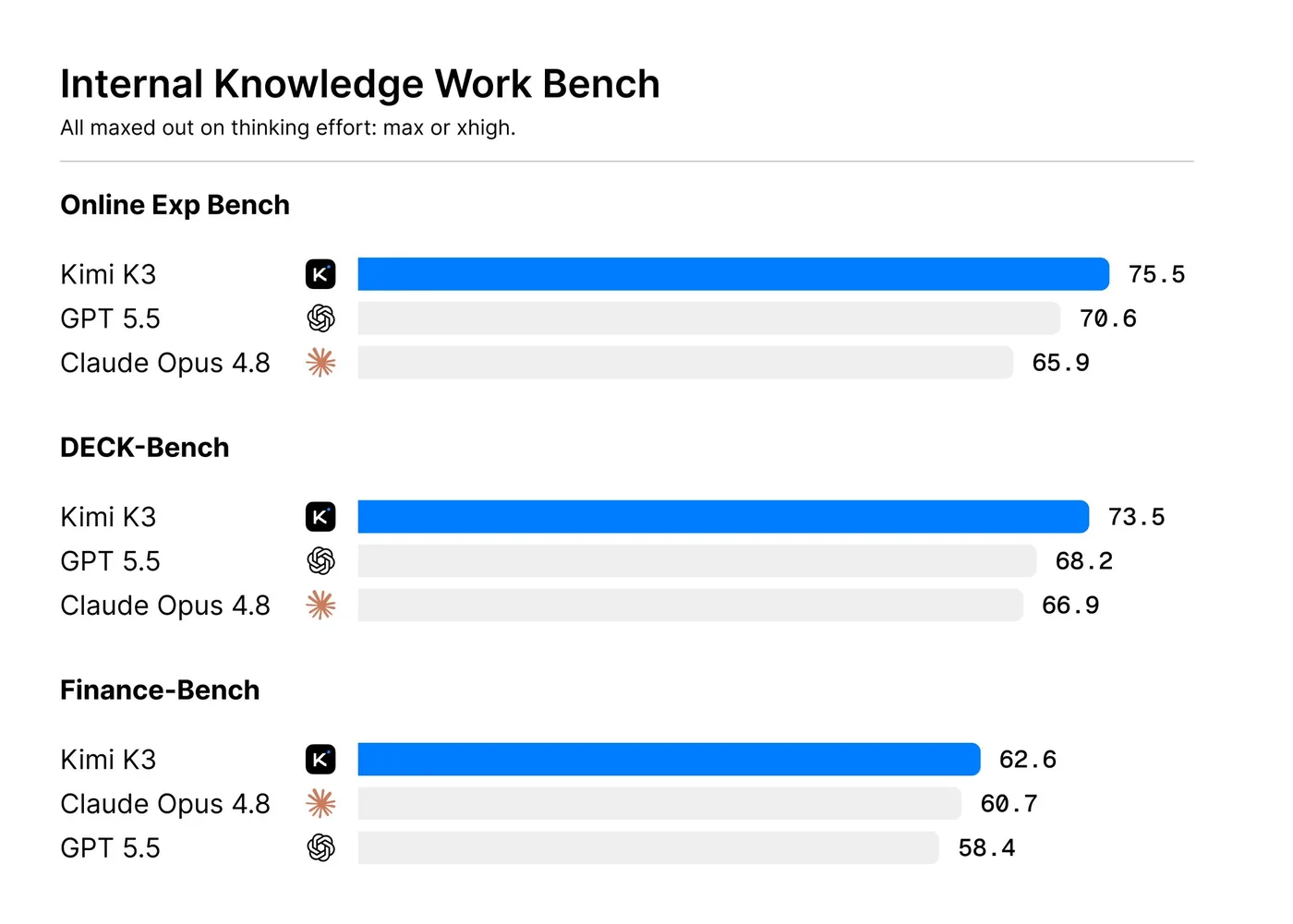
Source: Official @Kimi_Moonshot follow-up post, July 16, 2026.
Local reality: size without a fake VRAM table
People keep asking for a neat “RTX 5090 / M4 Ultra” chart. We will not invent one.
What we can say without guessing numbers:
- 2.8T total parameters is more than twice the ~1T-class open Kimi models many people already found “huge.”
- Moonshot describes MoE-style sparsity (their blog: activate 16 of 896 experts) and quantization-aware training (they mention MXFP4 weights / MXFP8 activations). That can shrink serving cost relative to a dense 2.8T—but it does not turn K3 into a laptop toy.
- Their 64+ accelerator deployment recommendation is the closest thing to an official hardware vibe check. If you don’t already operate that class of box, your practical path is API, app, or a future host (vLLM partners, cloud endpoints)—not
ollama pullfantasies.
When weights appear, the useful artifacts will be: repo id, license, quant flavors, vLLM/llama.cpp/etc. support notes, and minimum cluster recipes. Until those exist, any “you only need X GB” blog is fan fiction.
What to do between now and July 27
Think of this as a ten-day prep window, not a download countdown timer.
If you build products
- Wire
kimi-k3behind a feature flag on one high-value workflow. - Log tokens + $ + success rate next to K2.6 / K2.7 Code on the same tasks.
- Stabilize prompt prefixes (system + repo digest) so cache hits actually fire—Moonshot claims high cache hit rates on coding workloads when the architecture cooperates.
- Don’t delete your K2.7 Code path. Flagships and coding specialists can coexist.
If you care about self-hosting
- Bookmark Moonshot on Hugging Face and the K3 blog.
- Watch for a technical report + vLLM / partner notes (they explicitly called out ecosystem alignment and a KDA-related vLLM contribution).
- Budget for cluster or hosted inference, not a single consumer card.
- Keep running K2.6 / K2.7 Code weights if you already self-host those—they’re the open models you can actually pull today.
If you just want to try the model
Open the app or API, run your hard task once, and decide whether the bill feels worth it. You don’t need a 2.8T checkpoint to form an opinion.
July 27 checklist (when the day comes)
Use this list only after something real appears—don’t “pre-celebrate.”
- Official announcement or blog update confirming weights are out (not just “soon”)
- Hugging Face (or other) repo under Moonshot with files, not an empty placeholder
- LICENSE text you actually read
- README: how to serve (vLLM / other), known limits, quant options
- Whether inference partners list public endpoints the same day
- Update your own runbook: API default vs self-host vs hybrid
We’ll update our Kimi K3 status hub when primary sources change. Trust those over screenshots.
Noise filters (the lies that travel fast)
“It’s already fully open-source on HF.”
Not as a complete public K3 weight release—not that we’ve seen verified under Moonshot’s org as of July 17. Product access ≠ weight dump.
“Open weights = free unlimited K3 on my PC.”
Open weights remove a vendor gate. They do not remove physics, electricity, or cluster ops.
“Arena / one UI demo means local quality is solved.”
Frontend Arena headlines and one-shot UI videos are interesting product signals. They say nothing about your ability to load 2.8T at home.
“July 27 is guaranteed on my timezone with zero slip.”
Official language is by July 27, 2026. Treat it as a commitment to watch, and re-verify if the day moves. Promises can slip; your architecture shouldn’t depend on a single calendar cell without a fallback (API).
“Newest model replaces every older Kimi SKU.”
No. Keep the portfolio view: flagship general intelligence vs coding specialist vs cheaper long agent.
FAQ
Is Kimi K3 released?
Yes—in apps and as kimi-k3 on the API. See our release guide.
Are open weights out?
Not as a finished public download you should plan production on (as of July 17). Official promise: by July 27, 2026.
Can I download Kimi K3 from Hugging Face today?
Plan on no until Moonshot publishes a real K3 repo. Older Kimi models (for example K2.6 / K2.7 Code) are separate downloads.
What should I run while I wait?
API / app K3 for evaluation; K2.7 Code for daily coding agents; K2.6 for proven cheaper long agents. Self-host the already-open K2.x weights if you must stay offline.
Is this site official?
No. Cross-check kimi.com/blog/kimi-k3 and platform.kimi.ai before you spend money or rack hardware.
Bottom line
K3’s “open” story is a two-act play. Act one already started: products and API. Act two is scheduled for late July: full weights, hopefully with the ecosystem glue (license, serving notes, partner stacks) so “open” means something engineers can operate.
Until that second act ships, the smart move is boring and profitable: pilot K3 where premium reasoning pays for itself, keep K2.7 Code for shipping, and ignore anyone selling you a consumer-GPU K3 install guide with no repo link.
Next reads: K3 release & when to switch · which model today · status hub · K2.7 Code · K2.6 release.