Kimi K3 vs Claude & GPT: Cost and When to Switch
Kimi K3 hub: Specs, pricing, API id → /kimi-k3. Timeline → /kimi-k3-status. In-family pick → K2.6 vs K2.7 vs K3.
Your feed says Kimi K3 “closes the gap with Claude” and “is another DeepSeek moment.” Your model picker still has Claude, GPT, and a new kimi-k3 button that costs real money.
So the real question isn’t “who won the launch charts?” It’s simpler:
Should you move work off Claude or GPT this week—and if so, which work?
Short answer (read this first)
- Don’t flip your whole stack to K3 because the headlines did.
- Do pilot K3 on hard + long jobs: multi-hour coding agents, fat repos, vision-in-the-loop UI, research packs that blow past 256K.
- Keep Claude (especially Sonnet-tier daily coding) and GPT (ecosystem tools, Codex, tiered Luna/Terra/Sol routing) where they already ship cleanly for you.
- Inside Kimi, day-to-day IDE loops still often belong on K2.7 Code first; K3 is the flagship general brain, not an automatic replace-all.
This site is independent of Moonshot, Anthropic, and OpenAI. Prices below are public list rates as of mid-July 2026—always re-check platform.kimi.ai, Anthropic pricing, and OpenAI pricing before you budget.
Try Kimi free: Sign up free and claim rewards — up to 1 year of membership value. Prefer membership perks? Subscribe for more benefits.
What you’re actually comparing
People mash three different fights into one tweet:
| Fight | What it really means |
|---|---|
| K3 vs Claude Opus / Fable | Flagship-vs-flagship ego match |
| K3 vs Claude Sonnet 5 | Daily coding bill vs “Sonnet-priced” K3 |
| K3 vs GPT-5.6 Sol / Terra | Frontier coding agents vs OpenAI’s tier ladder |
K3 is Moonshot’s flagship: about 2.8T parameters, 1M-token context (roughly how much of a project or research pack it can hold in one go), native vision, and thinking always on (at launch, effort is basically max only). The API id is kimi-k3. Full public weights are still a late-July promise (Moonshot said by July 27, 2026)—today you use product + API, not a casual laptop download. Details: K3 release walkthrough · open-weights reality check.
Claude and GPT are portfolios. Comparing only to Opus/Fable/Sol is how you get bill shock or false bargains. Compare like a grown-up: which SKU would you have used instead?
List-price cheat sheet (USD / 1M tokens)
Scan this once, then ignore “cheapest model wins.” Agent work is mostly output + retries + thinking tokens.
| Model (public list, mid-July 2026) | Input | Cached input (if published) | Output | Context note |
|---|---|---|---|---|
Kimi K3 (kimi-k3) | $3.00 | $0.30 | $15.00 | 1,048,576; flat rate (no long-context surcharge on the public card) |
| Claude Sonnet 5 (intro through Aug 31, 2026) | $2.00 | often ~10% of input on cache hits | $10.00 | Then standard $3 / $15 from Sep 1, 2026 (per Anthropic launch notes) |
| Claude Sonnet 5 (standard) | $3.00 | ~$0.30 | $15.00 | Same headline band as K3 output |
| Claude Opus 4.8 | $5.00 | ~$0.50 | $25.00 | Flagship Claude band |
| GPT-5.6 Sol | $5.00 | $0.50 | $30.00 | OpenAI flagship tier |
| GPT-5.6 Terra | $2.50 | $0.25 | $15.00 | Mid tier—often the fair “daily” compare |
| GPT-5.6 Luna | $1.00 | $0.10 | $6.00 | Background / high-volume tier |
How to read it without a spreadsheet:
- K3 vs Sonnet 5 (standard) — same-ish list band ($3 / $15). You’re not buying “cheap China model”; you’re buying a different flagship shape at Sonnet money.
- K3 vs Opus 4.8 — K3 list is lower on input and output ($3/$15 vs $5/$25). That’s real—if quality holds on your tasks.
- K3 vs GPT-5.6 Sol — K3 list undercuts Sol hard on output ($15 vs $30). Against Terra, the story is closer: Terra is $2.50/$15.
- Cache — Moonshot markets high cache-hit rates on coding workloads; K3 cache hits at $0.30. If your harness re-sends the same repo/system prompt, this matters more than the headline.
Rough sanity check (uncached): 1M input + 200K output ≈ $6 on K3 vs ≈ $10 on Opus 4.8 vs ≈ $11 on GPT-5.6 Sol. Your real job will burn differently—especially with always-max thinking.
Capability: separate signal from marketing
Moonshot’s launch post is explicit: overall, K3 still trails the top proprietary models they name (Claude Fable 5, GPT-5.6 Sol), while claiming frontier-level results across their suite and strong long-horizon coding. That honesty matters more than any influencer thumbnail.
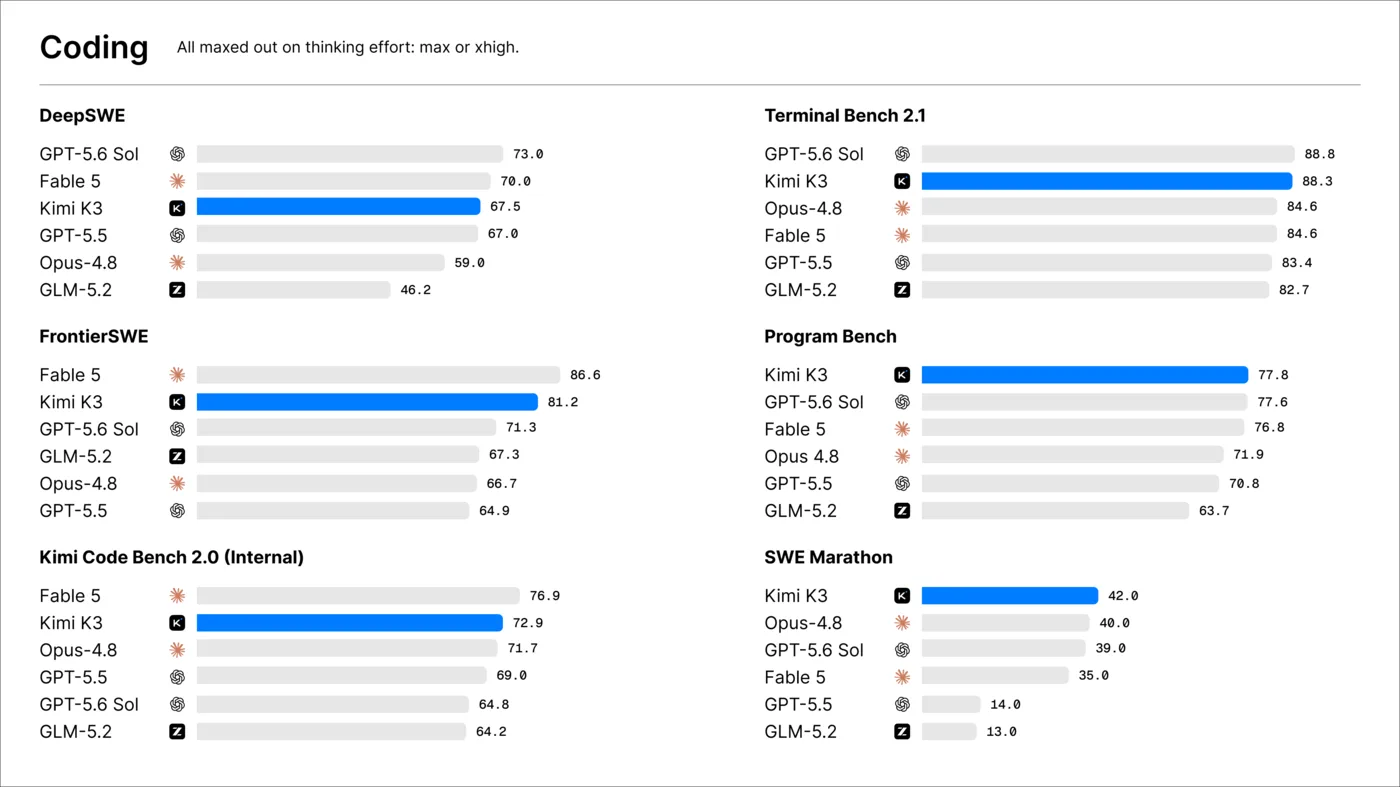
Source: Official @Kimi_Moonshot K3 launch media, July 16, 2026; same charts as the Kimi K3 blog.
Coding and agents
- Long-horizon coding is the product pitch: multi-hour sessions, big repos, terminal tools, less hand-holding. Treat launch demos (kernel work, MiniTriton-style compiler stories, research pipelines) as existence proofs, not your Monday estimate.
- Frontend / visual loop is where social proof spiked: multiple reports put K3 at #1 on Frontend Code Arena (~1679 Elo in mid-July writeups), with a huge jump from K2.6. Human preference on UI code ≠ “best model for every backend PR.” Re-check the live Arena board before you rewrite a roadmaps slide.
- Agent / knowledge-work charts from the same launch pack show competitive agent and vision-agent scores. Use them as directions, then run your harness (Claude Code, Kimi Code, Codex, Cline, custom).
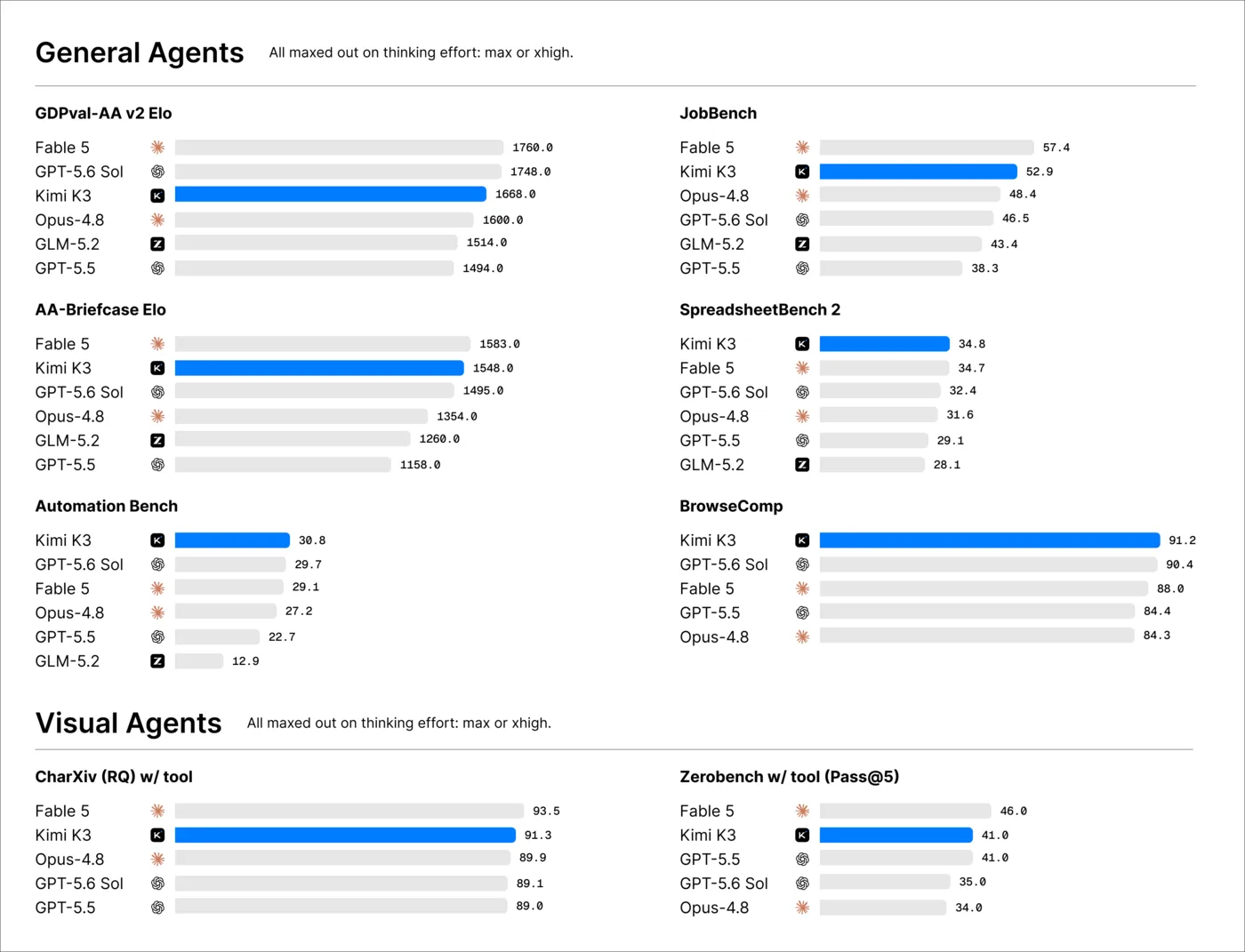
Source: Official @Kimi_Moonshot K3 launch media, July 16, 2026.
Where Claude and GPT still win by default
| You care about… | Bias today |
|---|---|
| Polish, safety defaults, enterprise procurement already on Anthropic | Stay on Claude until a blind bake-off says otherwise |
| OpenAI ecosystem (Assistants patterns, Codex, GPT tier routing Luna→Terra→Sol) | Keep GPT as the spine; add K3 as a specialist lane |
| Lowest friction IDE loop that already works | Don’t “upgrade” out of boredom |
| Self-host full weights today | Not K3 yet—weights promised by July 27; run API/product until the HF card exists |
Decision tree: what should you open this week?
If you’re a product engineer in an IDE all day
- Keep Claude Sonnet 5 (or whatever currently merges clean PRs) as default.
- Add
kimi-k3(or Kimi Code/model) for: large refactors, UI from screenshots, multi-package migrations, jobs that thrash 256K windows. - Inside Kimi family, still try
kimi-k2.7-codefor routine ship-the-PR loops—specialist beats flagship logo. See Kimi Code guide.
If you run long autonomous agents
- Pilot K3 when the run is long, tool-heavy, and multi-domain (code + docs + vision).
- Keep Claude Opus / GPT Sol for high-stakes paths where one bad improvisation is expensive—Moonshot itself warns K3 can be over-proactive on ambiguous tasks (constrain with system prompt /
AGENTS.md). - Keep K2.6 if a cheaper long agent already works and you’re not hitting context walls. Which Kimi model?
If leadership asked “are we behind on the Chinese open model?”
- Ship a two-week pilot, not a vendor migration:
- 5 hard internal tasks (same harness, same eval)
- Log pass rate, human edits, $ per accepted task, not just benchmark screenshots
- Decide per workflow, not per brand
If you only wanted open weights
- Use API/product now; calendar July 27, 2026 as Moonshot’s stated weight deadline; verify repo + license when it appears. Open weights guide. A 2.8T-class model is datacenter-shaped, not a 24GB laptop fantasy.
Myths to drop (so you don’t ship a bad plan)
| Myth | Better take |
|---|---|
| “K3 beat Claude, so switch everything” | Moonshot says it still trails Fable 5 / GPT-5.6 Sol overall; strong on many suites ≠ universal win |
| “K3 is the cheap model” | $3/$15 is Sonnet-standard band, not Haiku money; cache and thinking still burn |
| “Arena #1 = best coding model” | Frontend preference leader ≠ Terminal-Bench god-mode on your monorepo |
| “Open weights means free local tonight” | Product is live; full weights are scheduled, not already in your ollama list |
| “One model should do heartbeats and kernel work” | Route: cheap tier for noise, flagship for hard jobs—on any vendor |
Watch-outs unique to K3 right now
Moonshot’s own limitations section is worth a sticky note:
- Thinking history — K3 was trained expecting full thinking history back in the harness. Mid-session model switches or broken history can get ugly. Prefer compatible agents (e.g. Kimi Code).
- Always-max effort at launch — low/high modes “later.” Budget like a reasoning model that doesn’t coast.
- Proactiveness — great for long jobs; annoying if you need tight guardrails. Write sharper constraints.
- Vendor lock vs weights — API today, open-weight story mid-flight. Plan procurement with both timelines.
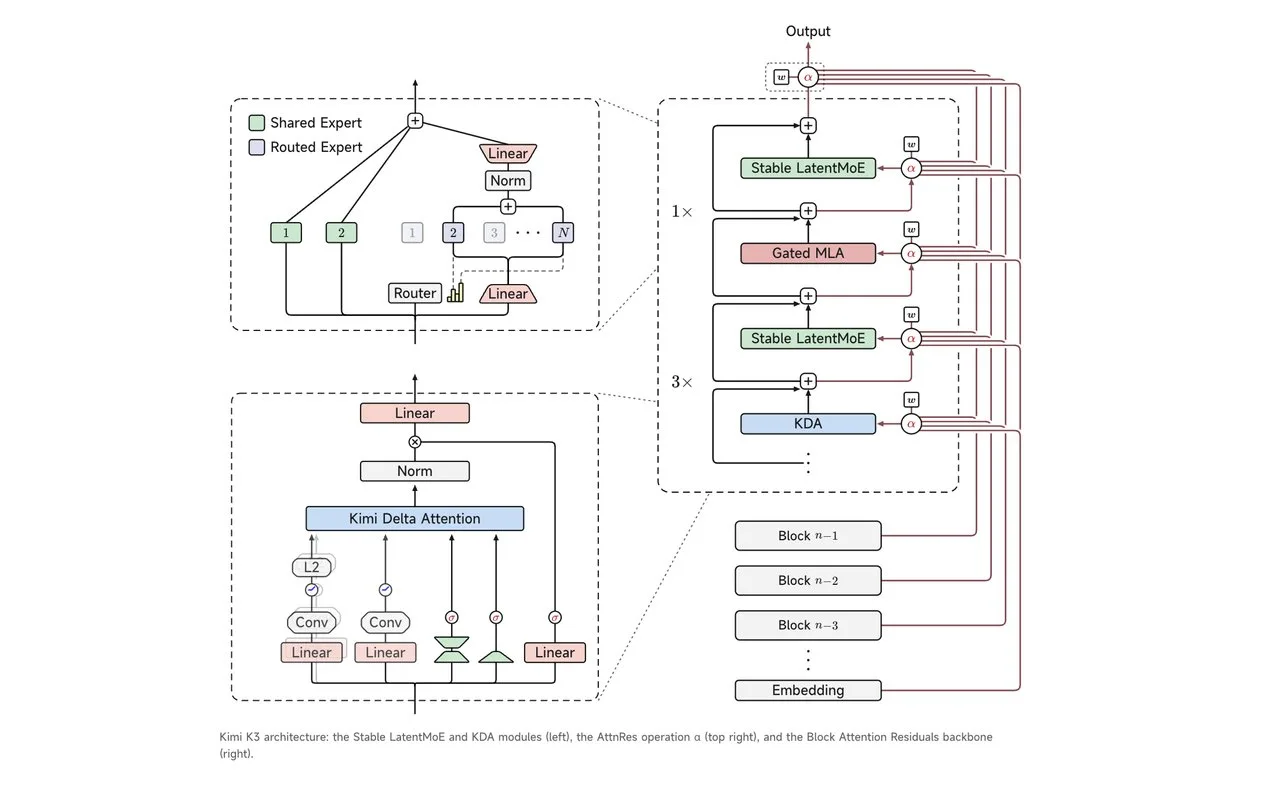
Source: Official @Kimi_Moonshot architecture media, July 16, 2026; described on the Kimi K3 blog.
Bottom line
Kimi K3 is real competition at Sonnet-class list pricing with a 1M context story and serious coding/agent ambition—not a free lunch and not a certified Claude killer on every axis.
Use it when the job is hard and long. Keep Claude and GPT where they already earn their keep. Re-price after you’ve measured accepted work per dollar, not after one launch chart.
Where to go next
- Full K3 product hub → /kimi-k3
- Release-day specs & when to leave K2.x → /blog/30-kimi-k3-release
- Open weights countdown (honest version) → /blog/31-kimi-k3-open-weights-july-27
- K2.6 / K2.7 / K3 family chooser → /blog/29-kimi-which-model-k26-k27-k3
- Kimi Code / K2.7 → /kimi-code · /kimi-k27
- Official model post → kimi.com/blog/kimi-k3