Kimi K3 Ollama & VRAM: Can You Run It Locally Yet?
Kimi K3 hub: Specs, pricing, API id → /kimi-k3. Timeline → /kimi-k3-status. Open-weights calendar → July 27 reality check.
You typed kimi k3 ollama, kimi k3 vram, or kimi k3 download because a feed said the model is “open.” Then you opened Hugging Face or the Ollama library and… no clean install path.
That gap is not your fault. It’s the difference between marketing “open” and files you can actually load.
This guide answers the local questions only: Can you run Kimi K3 on your machine yet? How much VRAM? When will Ollama/GGUF show up? What should you do this week instead?
This site is independent of Moonshot. Facts below track public docs as of July 21, 2026—re-check the official K3 blog and Moonshot on Hugging Face before you buy GPUs or trust a random repo.
Short answer (read this first)
- No reliable public full-weight dump for K3 yet (as of this writing). Product + API are live; the company said full weights by July 27, 2026. Until a real Moonshot repo with files appears, you cannot honestly
ollama pullfull K3. - Scale is ~2.8 trillion parameters with MoE-style sparsity (official: activate 16 of 896 experts). That can help serving efficiency relative to a dense 2.8T—it does not make K3 a 24GB laptop toy.
- Moonshot’s own serving note points at supernode-style deployment with 64+ accelerators. Read that as: datacenter-shaped, not “one gaming card and a dream.”
- What works today: kimi.com, Kimi Work, Kimi Code, and API model id
kimi-k3on platform.kimi.ai. For already-downloadable open weights, stick to K2.6 / K2.7 Code family cards—not K3.
One sentence: use the API or app this week; treat local K3 as a late-July event you re-verify, not a command that works tonight.
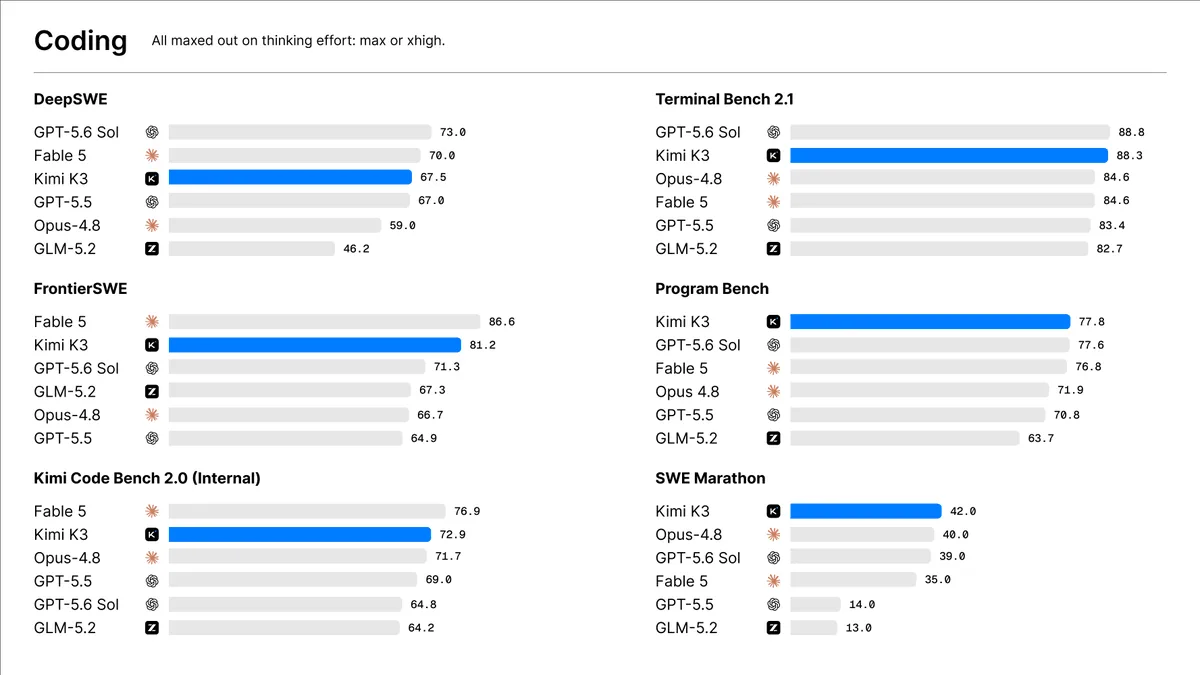
Source: Community share of official K3 launch messaging; cross-check Kimi K3 tech blog, Moonshot AI, July 16, 2026.
What people are actually searching (four different jobs)
Search engines mash these into one blob. Separate them:
| What you typed | What you probably want | Available today? |
|---|---|---|
| kimi k3 huggingface / download | Official weight files | Not as a finished public K3 checkpoint (re-check near July 27) |
| kimi k3 ollama / gguf | One-command local chat | Not yet—needs weights + community/runtime packaging |
| kimi k3 vram / local requirements | “Will my GPU fit?” | No honest fixed GB table yet—scale + official multi-accelerator guidance only |
| kimi k3 self host | Run in your VPC/cluster | After weights + stack support (vLLM / partners); plan cluster-class iron |
If you only remember one row: download intent ≠ Ollama intent ≠ “free unlimited on my PC.”
For the broader open-weights calendar (not just local hardware), see our open weights July 27 post. This page goes deeper on Ollama / VRAM / self-host reality.
What Moonshot has actually said (local-relevant bits)
From the official Kimi K3 announcement (July 16, 2026):
| Fact | Why locals care |
|---|---|
| 2.8T parameters, first open 3T-class claim | Your mental model of “big open model” just jumped again |
| 1M-token context, native vision | Long context + multimodality raise memory and I/O pain when self-hosting |
| MoE: effectively 16 of 896 experts + Stable LatentMoE framing | Sparse activation helps compute, not magic “laptop fits total params” |
| Quantization-aware training: MXFP4 weights / MXFP8 activations (their wording) | Suggests they care about efficient serving—not a published consumer quant card |
| Full weights by July 27, 2026 + tech report around that | Calendar event, not a download button today |
| Aligning with inference partners and open-source maintainers | Expect stack lag (vLLM, etc.) even after files appear |
| Recommend 64+ accelerator supernode-style deploy | Closest official hardware vibe check—not a 4090 install guide |
API list pricing (USD / 1M tokens) while you wait: cache-hit input $0.30, cache-miss input $3.00, output $15.00. Launch thinking is max effort by default—short prompts can still burn serious reasoning tokens.
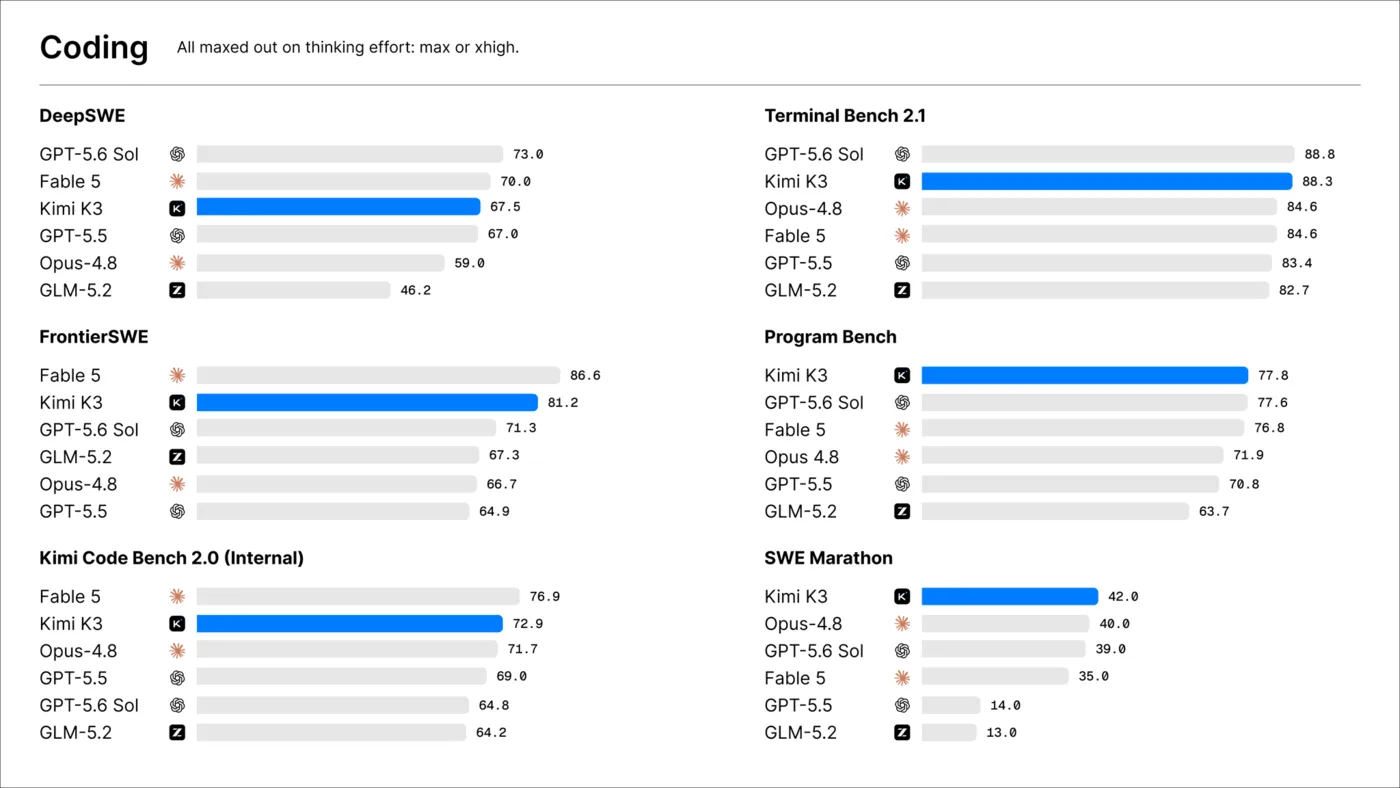
Source: Official K3 launch media / Kimi K3 blog, July 16, 2026.
VRAM reality (without a fake GB table)
People want a neat chart: “Q4 = XX GB, Q5 = YY GB, needs 2×H100.”
We will not invent one.
Why that would be dishonest right now:
- Full public K3 weights are not confirmed on disk for the community yet.
- Official quant recipe for your machine is not a finished consumer product page.
- Community GGUF/AWQ/EXL2 builds—if they appear—usually lag the day-0 dump, and quality varies.
- Activated experts ≠ total parameters on disk. MoE sparsity can cut active compute; it does not automatically mean “only store 16 experts.”
What you can use as a reality check:
- 2.8T total is in a different universe from “small open coder that runs on a laptop.”
- Moonshot’s 64+ accelerators recommendation is the company’s own serving shape for competitive throughput—not a hobbyist footnote.
- If you do not already operate multi-node GPU clusters (or pay someone who does), your practical paths are API, product apps, or a future managed host—not “I’ll quantize it on the weekend and forget electricity.”
When weights land, the useful artifacts will be: repo id, LICENSE, file sizes, official serving notes, partner endpoints, and first trustworthy quant READMEs. Until those exist, any “exact VRAM for K3 on a 5090” post is fan fiction.
Ollama, GGUF, and “how to run locally” timelines
Today (July 21, 2026):
- No verified one-shot Ollama library entry for full Kimi K3 that we can point you to with confidence.
- GGUF packs require base weights + a conversion pipeline + someone publishing them. None of that is “done” until the official dump (and community tooling) exist.
- Older Kimi open models (for example K2.6, K2.7 Code) are the ones you can already pull from Hugging Face and wire into local stacks—do not confuse their tags with K3.
After weights drop (watch the calendar, don’t pre-celebrate):
- Confirm a Moonshot-owned (or clearly official) repo with real files—not a placeholder, not a mirror with a funny name.
- Read the LICENSE on that repo (prior Kimi open lines often used a Modified MIT-style license; K3 is not settled until the file ships).
- Check vLLM / SGLang / other support notes—Moonshot already said ecosystem alignment matters for K3’s architecture (including KDA-related serving work mentioned on their blog).
- Only then look for Ollama / GGUF community ports. Expect days-to-weeks of lag for “works on my machine” blogs, and longer for quality quants.
- Re-evaluate cost: self-host cluster + power + ops vs API $3/$15 (plus cache hits). Many teams will keep API for peak intelligence and host smaller open models for offline bulk.
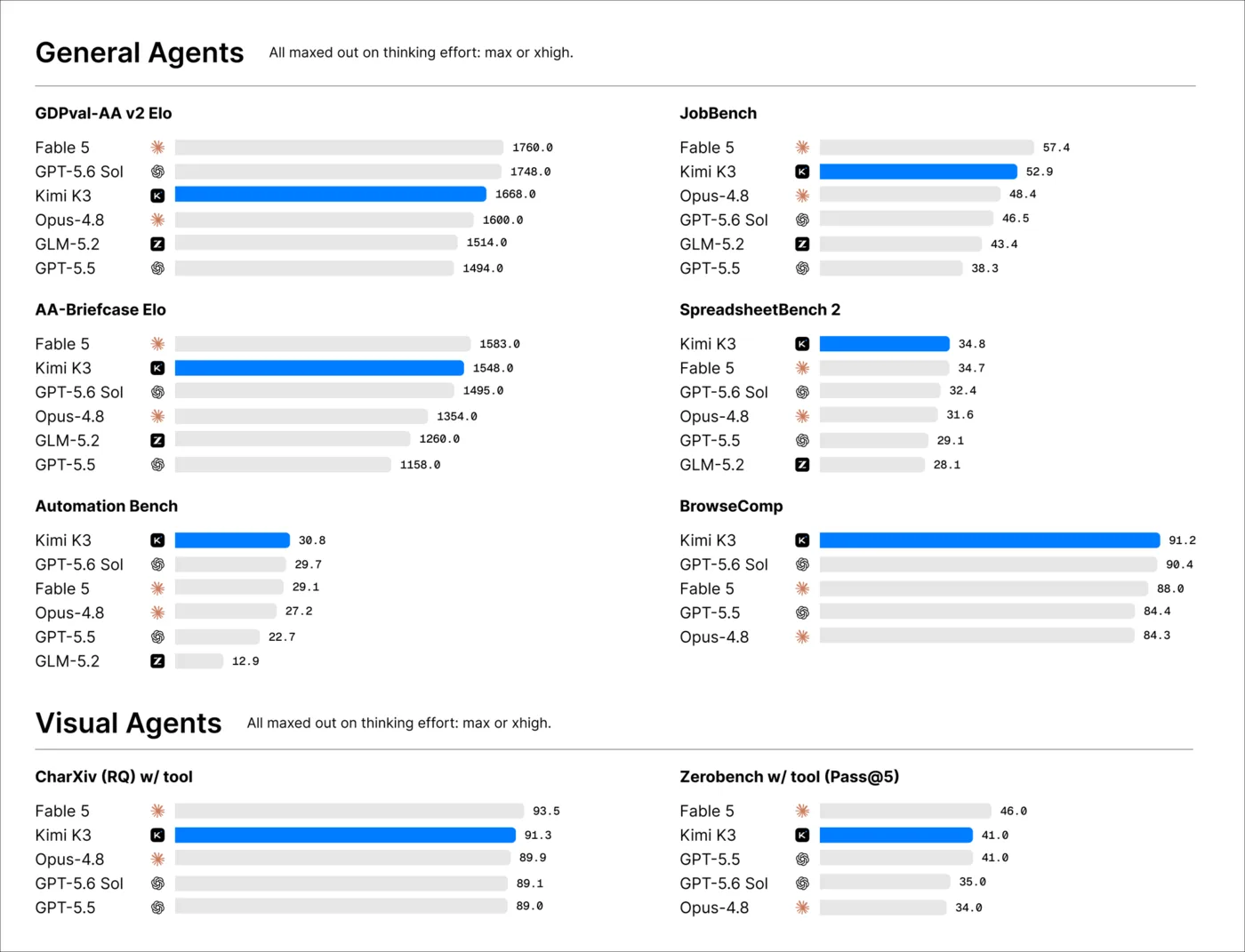
Source: Official K3 launch media / Kimi K3 blog, July 16, 2026.
July 27 checklist (for local / self-host people)
Use this only when something real appears—not as a party invitation for empty calendars.
- Official confirmation that weights are out (blog/X/HF), not just “soon”
- Hugging Face (or other) repo under Moonshot with downloadable shards
- LICENSE read end-to-end
- README: serving path (vLLM / other), known limits, multimodal notes
- File sizes / quant options listed by someone credible (prefer official or large hosts first)
- Whether Ollama / llama.cpp / etc. has a real, versioned support path
- Your decision tree: API default vs managed host vs self-host cluster
- Budget for ops time—not just GPUs
We’ll track high-level status on /kimi-k3-status. Trust primary sources over screenshots.
What to run this week instead
| Your goal | Do this |
|---|---|
| Feel K3 quality on a hard task | App / kimi-k3 API with a fixed pilot budget |
| Ship code every day | Kimi Code + keep K2.7 Code path warm |
| Stay local now | Self-host already-open K2.x weights (K2.6 / K2.7 Code)—not K3 |
| “Free” product experiments | See honest free options—product quotas ≠ free API ≠ free self-host |
| Which SKU for which job | K2.6 vs K2.7 vs K3 |
If new signups or membership capacity are tight (Moonshot has publicly managed demand spikes after launch), the API and existing access paths still matter more than a missing local binary.
Noise filters (local edition)
“It’s already on Ollama.”
Treat unverified library names and mirror tags as suspect until they point at a real Moonshot (or clearly derived) checkpoint and a working runbook.
“Open weights = free unlimited local K3.”
Open weights remove a vendor gate. They do not remove physics, electricity, multi-GPU ops, or license limits.
“MoE means my 24GB card is fine.”
Sparsity helps active compute. Total storage, expert routing, long context, and vision still hurt. Official serving guidance is multi-accelerator.
“Someone’s HF card named kimi-k3 must be official.”
Check org, files, license, announcement link. Prefer huggingface.co/moonshotai over random renames.
“I’ll just wait and skip the API forever.”
Fine for research curiosity. Bad for product deadlines. Pilot K3 where premium reasoning pays; keep cheaper/open SKUs for bulk.
FAQ
Can I download Kimi K3 today?
Plan on no for a complete official public dump as of July 21, 2026. Official promise: full weights by July 27, 2026. Re-check Moonshot’s org and the K3 blog.
Can I run Kimi K3 on Ollama today?
Not in any trustworthy, complete form we can recommend. No weights → no honest Ollama path.
How much VRAM do I need?
Unknown as a precise consumer number. Use official scale + 64+ accelerator serving guidance as a gut check: if you don’t already run cluster GPUs, budget for API or hosted inference.
Is K3 open source or open weight?
Launch language emphasizes open weights for a 3T-class model. Final license text ships with the files—read it then. “Open” in a headline is not a substitute for LICENSE.
What about K2 models locally?
Earlier open Kimi lines (e.g. K2.6, K2.7 Code) are the practical self-host options today. Don’t paste a K2 tag into a script and call it K3.
Is this site official Moonshot?
No. Cross-check kimi.com/blog/kimi-k3 and platform.kimi.ai before you spend money or rack hardware.
Bottom line
Local searchers are not crazy—HF / download / Ollama / VRAM demand is real. What’s missing is the artifact: a public K3 weight release you can verify, plus a stack that actually loads it.
Until that lands, the smart play is boring:
- Pilot K3 on the product or API where a hard task is worth the token bill.
- Self-host the open K2.x models you can already pull if you need offline iron.
- Ignore “install K3 on a laptop tonight” guides that never show a real repo.
- Re-check around July 27—with the checklist above, not with hope alone.
Next reads: open weights July 27 · K3 release guide · free options · which model · status hub.