Self-Host Kimi K3 on Day 0: vLLM Path vs Ollama Laptop Myth
Kimi K3 hub: Specs, pricing, API id → /kimi-k3. Timeline → /kimi-k3-status. Ollama/VRAM reality → /blog/34-kimi-k3-vram-ollama-local-requirements. Open-weights calendar → /blog/31-kimi-k3-open-weights-july-27.
Your feed says Kimi K3 open weights drop July 27. Someone replies with a Mac Mini screenshot. Someone else pastes a mystery GGUF “one-click Ollama.” Meanwhile you’re trying to answer a simpler job: can my team self-host this, or is that just hype?
Short version: treat self-hosting as a cluster / vLLM problem, not a laptop chat app problem. Product and API are already live. Full public weights are still a calendar event you re-verify on Hugging Face—not a guarantee that ollama pull works tonight.
This site is independent of Moonshot. Specs and dates below track public docs and partner blogs as of July 27, 2026; re-check the Kimi K3 blog, platform docs, and vLLM’s K3 preview before you buy iron or trust a random repo.
Short answer (read this first)
- Two different jobs.
- “I want K3 quality today” → kimi.com, Kimi Code, or API id
kimi-k3on platform.kimi.ai. - “I want weights in my VPC” → wait for a Moonshot-owned HF repo with real files + a day-0 serving stack (vLLM is the public path Moonshot and partners are prepping).
- “I want K3 quality today” → kimi.com, Kimi Code, or API id
- As of this writing, HF
moonshotai/Kimi-K3is still an Upcoming release page (countdown / notify)—not a finished download with safetensors. Social posts that say “already open” are usually reading the promise, not the Files tab. - Ollama on a single gaming GPU is the wrong mental model for full 2.8T-class K3. Official serving language points at supernode / multi-accelerator deployment, not a 24GB toy.
- vLLM’s July 22 preview is the best public “how the industry will serve this” note: day-0 model path, KDA-aware prefix caching, Docker recipes, NVIDIA + initial AMD work—not a consumer one-liner.
- Already-downloadable open Kimi lines (e.g. K2.6 / K2.7 Code on Hugging Face) are what you can self-host today if you need offline weights while K3 files are still pending.
One sentence: use the API or product for intelligence this week; use vLLM + real weights for self-host when the Files tab is real—don’t confuse those two doors.
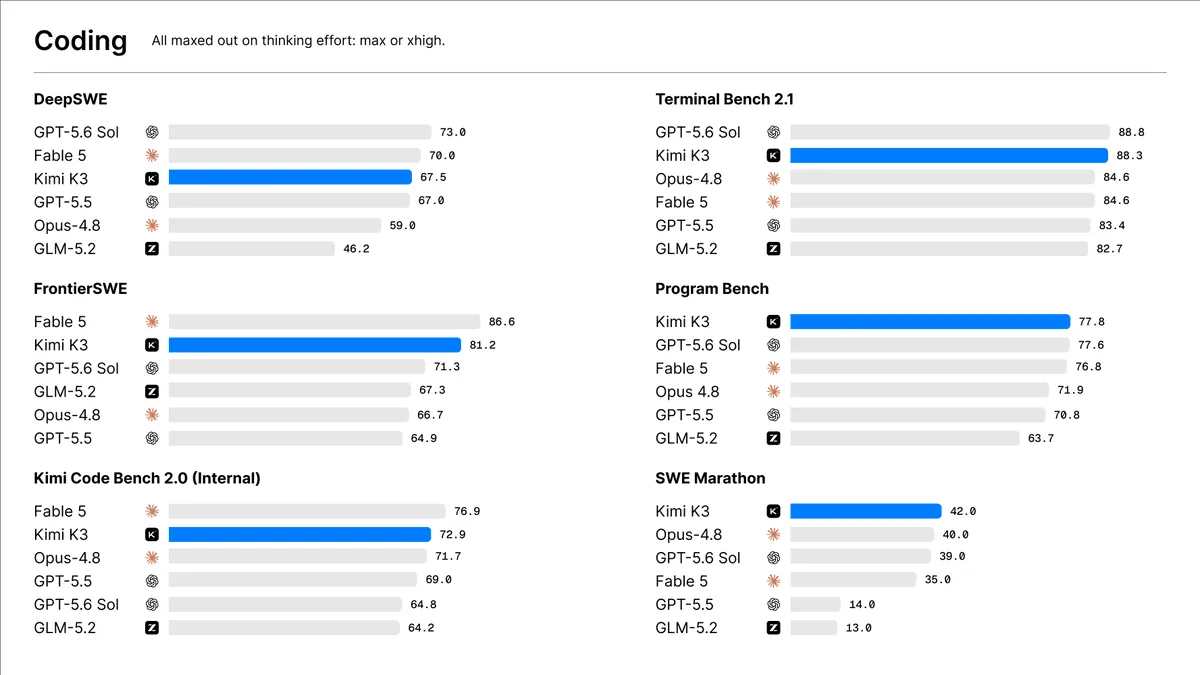
Source: Official K3 launch messaging / Kimi K3 tech blog, Moonshot AI, July 16, 2026.
Who this guide is for (and who it isn’t)
| You are… | Read this as… | Skip the fantasy of… |
|---|---|---|
| Infra / platform engineer prepping a GPU fleet | Day-0 checklist + stack pointers | Instant Ollama on a laptop |
| Founder who heard “open = free forever on my Mac” | Cost + ops reality check | Running full K3 offline on one consumer card |
| Developer who just wants coding help | Product / API first | Waiting days for a perfect local stack |
| Research lab that needs weights for audit / fine-tune | HF + LICENSE + model card verification | Trusting renamed community mirrors |
If you only searched “kimi k3 ollama”, also read our VRAM & Ollama post—that page is the local-hardware honesty check. This page is the self-host / serving path.
What “open weights day 0” actually means
Moonshot’s public story (see the K3 announcement):
- Product + API first (live since ~July 16, 2026): chat, Work, Code,
kimi-k3API. - Full model weights by July 27, 2026—a commitment to ship files, not a magic “already on every mirror” claim.
- Architecture that changes serving: Kimi Delta Attention (KDA), Attention Residuals, sparse MoE (official framing: 16 of 896 experts active per token), ~2.8T total params, 1M context, native vision.
- Explicit note that they contributed KDA-related prefix-cache work to the vLLM community, to release alongside the model—because KDA does not behave like classic full-attention KV cache.
So “day 0” for self-hosters is really two drops:
- Weights + LICENSE + model card (usually Hugging Face under
moonshotai/…). - Serving code that understands K3 (vLLM preview points at model path, parsers, kernels, Docker, recipes).
Either one without the other is a half-open door.
Path A — Product & API (what most people should open today)
You do not need self-host to try frontier K3 quality:
| Door | Good for | Watch-outs |
|---|---|---|
| kimi.com / app | Feeling the model, knowledge work | Quotas, membership capacity (see subscription pause note) |
| Kimi Code | IDE / terminal coding agents | Pick the right model for the job (which model) |
API kimi-k3 | Automation, tools, OpenAI-compatible clients | Pay-as-you-go: cache-hit $0.30 / miss $3 / output $15 per 1M tokens on public cards—see API pricing guide |
If your goal is “ship a feature this sprint,” API + product win. Self-host is for data residency, air-gap, custom fine-tune, or unit economics at huge volume—not for FOMO.
Source: Official K3 launch media / Kimi K3 blog, July 16, 2026.
Path B — Self-host via vLLM (the serious day-0 path)
What vLLM publicly promised (July 22, 2026)
The vLLM team preview is the clearest “ecosystem readiness” post we have before full open-source day. In plain language, they say they are preparing:
- Day-0 open-source serving for the weight release: model implementation, Docker images, deployment recipes, production validation
- KDA-aware prefix caching (classic paged KV tricks are not enough for recurrent KDA state)
- Kernel / performance work across KDA prefill & decode, Attention Residuals, MoE (MXFP4 path in their release framing), multimodal pieces
- NVIDIA recipes under final tuning + an initial AMD path
That is infra language. It is not “paste this into Ollama on Windows and chat.”
How to think about day-0 serving (checklist, not a frozen CLI)
When weights appear, a sane self-host runbook looks like this—always prefer the official model card and vLLM docs over any blog, including this one:
- Verify the repo
- Org should be
moonshotai(or another source Moonshot links from the official blog). - Real Files (shards), not only “Upcoming release” marketing.
- LICENSE read end-to-end (prior Kimi open lines often used a Modified MIT-style license; do not assume K3 until the file ships).
- Org should be
- Pin a serving build that claims K3 / KDA support
- Follow vLLM’s post and the version they tag for day-0—nightly/main branches move.
- Expect tool-call / reasoning parsers and multimodal flags specific to Kimi, similar to earlier K2-family recipes.
- Plan parallelism like a MoE giant
- 2.8T-class sparse MoE is about expert parallelism + bandwidth, not one
tensor-parallel-size 1experiment. - Official product docs have pointed at supernode-style multi-accelerator serving for competitive throughput—read that as datacenter-shaped.
- 2.8T-class sparse MoE is about expert parallelism + bandwidth, not one
- Be humble about 1M context
- Cloud API “1M flat” is not the same as “I set
--max-model-len 1048576on day one and it flies.” - Start with a shorter max length, measure prefill/decode, then stretch.
- Cloud API “1M flat” is not the same as “I set
- Separate “weights on disk” from “production SLO”
- Day-0 often means it boots. Production means monitoring, PD disaggregation, cache hit rates, failure domains—vLLM’s post explicitly talks about those hard parts.
We will not paste a copy-paste vllm serve … line with fake flags as if it were blessed. Wrong flags rot in hours; the model card + vLLM release notes are the source of truth the day files land.
Hardware reality (without inventing a fake GB table)
People want: “K3 Q4 = XX GB on a 4090.”
We will not invent that table.
What you can hold onto:
- Total scale (~2.8T) and sparse activation (16/896 framing) do not equal “laptop fits total params.” You still store a huge weight footprint; you only activate a subset per token.
- Community size guesses for weight downloads often land in the hundreds of GB to ~1+ TB band depending on quant story (MXFP4 vs higher precision)—treat any number as unofficial until the model card lists file sizes.
- Moonshot’s own 64+ accelerator / supernode-style language is a serving shape, not a hobby footnote.
- If you do not already run multi-node GPU clusters (or buy managed inference), API or a managed host will beat a heroic weekend build for most teams.
For Ollama/GGUF timelines and “can I run it locally yet,” stay on the VRAM guide.
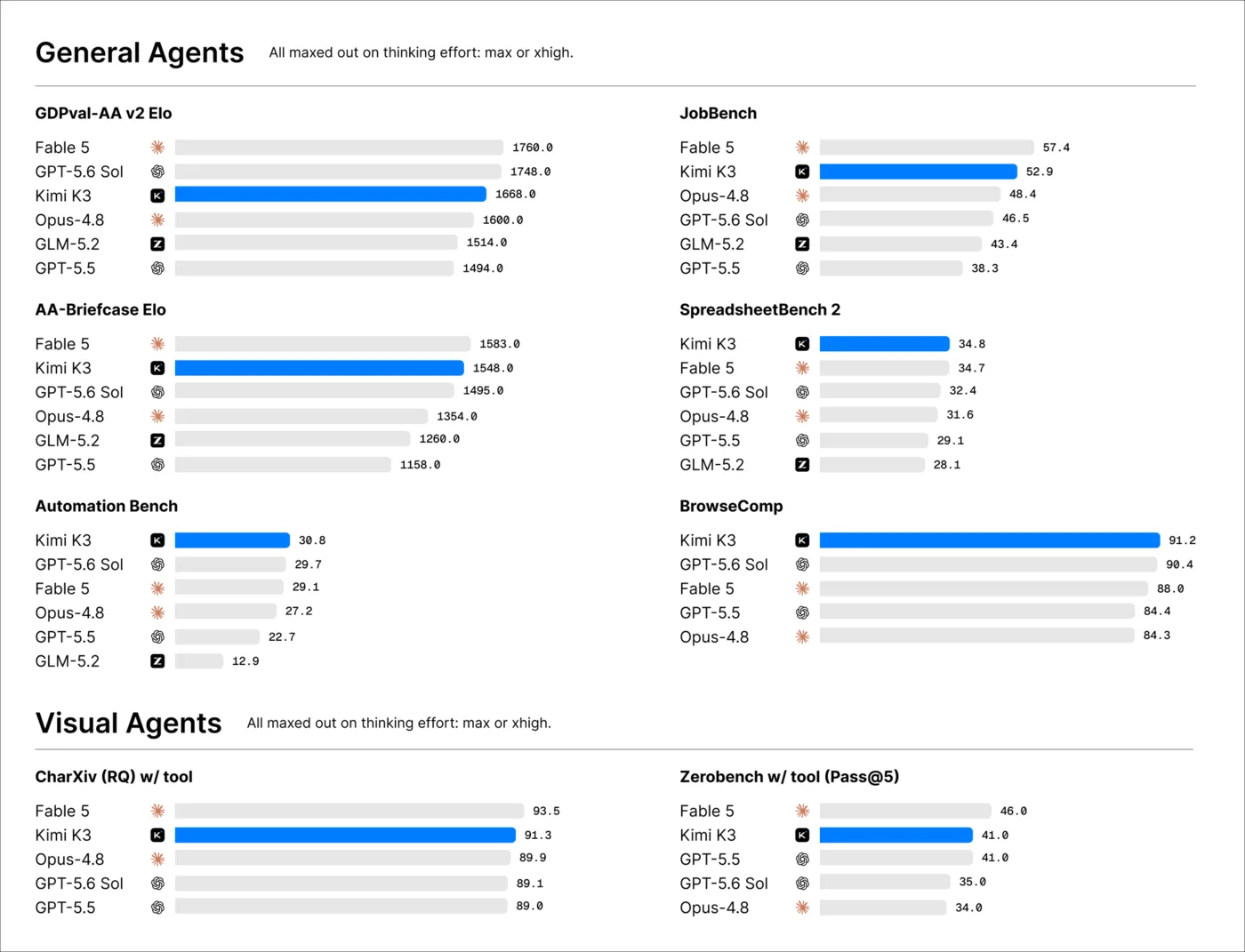
Source: Official K3 launch media / Kimi K3 blog, July 16, 2026.
Path C — The Ollama / “Mac Mini” myth (politely kill it)
Search demand for ollama, gguf, local, self host is real. The mistake is stacking them into one fantasy:
| Myth | Reality |
|---|---|
| “Open weights = free unlimited on my PC” | Open weights mean you can download and run under a license—not free electricity, free ops, or free VRAM |
| “If it’s on HF, Ollama has it tonight” | Ollama/llama.cpp ports usually lag official dumps; quality quants lag more |
| “2.8T MoE must fit like a 30B Q4” | Sparse compute ≠ tiny disk / RAM |
| “Any GGUF named K3 is fine” | Prefer official org + hashes; fake or abliterated packs are a real noise source on weight-drop days |
| “Self-host always cheaper than API” | Only after you price GPUs, power, idle time, on-call, and failed experiments against $3 / $15 API |
Healthy local path while you wait: self-host K2.6 / K2.7 Code (already on HF) for offline coding agents; use K3 via API for the hard jobs. Hybrid stacks beat purity contests.
Day-of checklist (when the calendar cell hits)
Use this when something actually appears—not when a repost says “dropping.”
Weights
- Official blog/X or HF page moves from Upcoming to downloadable Files
- Repo under
moonshotai(or clearly linked from kimi.com/blog/kimi-k3) - LICENSE + model card + listed shard sizes
- No dependence on a random third-party “Kimi-K3-abliterated” as your only copy
Serving
- vLLM (or other engine Moonshot names) version / image that documents K3
- Tool-call / reasoning parsers match the card
- Parallelism plan reviewed by someone who has run large MoE before
- Smoke test: health endpoint, short prompt, one tool call, one long-context prefill
Business
- Decision tree: API default vs self-host pilot vs managed host
- Security: weights access control, eval for hallucination / tool safety, not “open = deploy to prod same night”
What to do this week (decision tree)
If you need K3 quality before lunch
→ Product or API. Don’t block on weights.
If you are building a self-host pilot
→ Read vLLM’s K3 preview; reserve cluster capacity; draft the checklist above; practice on K2.6 / K2.7 Code weights so the pipeline is boring when K3 files land.
If you only have a gaming laptop
→ Enjoy K3 in the cloud product/API. Use smaller open models locally. Ignore “full K3 on 24GB” thumbnails.
If your compliance team needs open weights
→ Bookmark HF moonshotai/Kimi-K3 and the official blog; no production design until LICENSE + files are real.
Watch-outs (noise filter)
- Promise date ≠ Files tab. July 27 is Moonshot’s public target; verify artifacts.
- Hallucination / independent benchmark threads on social media vary—don’t paste third-party % into your runbook as “official.”
- Architecture keywords (KDA, AttnRes, MXFP4) are real engineering; they are not proof that consumer runtimes exist on day one.
- This site is not Moonshot support. When in doubt, official docs win.
Where next
- Status hub: /kimi-k3-status · product hub: /kimi-k3
- Open-weights calendar: /blog/31-kimi-k3-open-weights-july-27
- Local / Ollama honesty: /blog/34-kimi-k3-vram-ollama-local-requirements
- Free try doors: /blog/33-kimi-k3-free-how-to · how to use: /blog/36-how-to-use-kimi-k3
- Bill control: /blog/37-kimi-k3-api-pricing-cost-control
- Official: Kimi K3 blog · vLLM K3 preview · HF moonshotai
Bottom line: self-hosting Kimi K3 is a serious serving project (vLLM + multi-accelerator reality), not an Ollama party trick. Use the cloud doors while the Upcoming page is still Upcoming—and when the Files tab turns real, verify org, license, and stack before you trust any download.