Kimi K3 Hugging Face Download: Open Source Weights Live
Kimi K3 hub: Specs, pricing, API id → /kimi-k3. Timeline → /kimi-k3-status. Self-host path → /blog/38-kimi-k3-self-host-vllm-day0. Pre-drop calendar → /blog/31-kimi-k3-open-weights-july-27.
You searched kimi k3 huggingface, kimi k3 download, or kimi k3 open source—because the feed said the model is open, and you want a real Files tab, not another countdown page.
Good news: as of July 27, 2026, Kimi K3 open source weights are live. Moonshot published the model weights + technical report. The official Hugging Face repo moonshotai/Kimi-K3 has real safetensors shards, a LICENSE, and a full model card—not an “Upcoming release” teaser.
This site is independent of Moonshot. Below is a day-of practical read: where to download, what “open source / open weights” actually means for license and GPUs, and what you should do this week without burning a rack on FOMO.
Short answer (read this first)
- Yes—you can download Kimi K3 from Hugging Face now. Canonical link: huggingface.co/moonshotai/Kimi-K3. Tech report PDF: MoonshotAI/Kimi-K3 on GitHub. Launch narrative: Kimi K3 blog.
- Open source weights ≠ free infinite local chat. Full K3 is still ~2.8T parameters (MoE; ~104B active per token). Laptop Ollama fantasies stay fantasies—see our VRAM / Ollama honesty check and vLLM day-0 guide.
- Read the Kimi K3 License before you productize. Most research, internal use, and smaller commercial embeds are wide open. Hosting K3 as a paid API / Model-as-a-Service above a $20M annual revenue threshold needs a separate deal with Moonshot. Details below—don’t assume “Modified MIT from K2.x.”
- Most people still shouldn’t download first. Want intelligence today? Product + API id
kimi-k3. Want weights for VPC / fine-tune / audit? Labs and infra teams with a serving plan.
One sentence: the July 27 open-source file drop is real; treat it as a Hugging Face + cluster + license event, not a free chat app install.
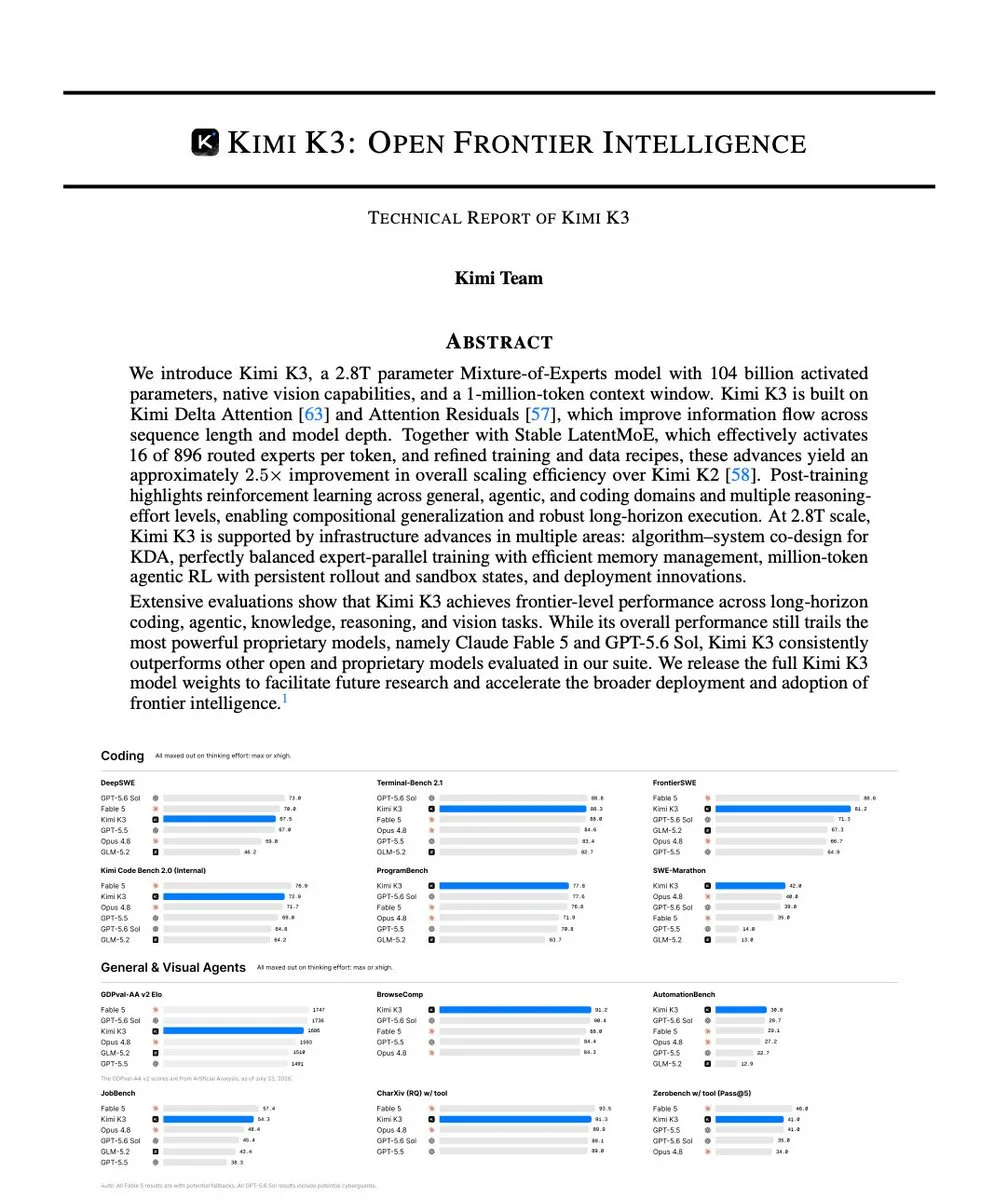
Source: @Kimi_Moonshot open-weights announcement, July 27, 2026.
What just changed (open source is no longer a calendar tease)
| Topic | Before today (our earlier guides) | As of July 27, 2026 |
|---|---|---|
| Hugging Face Files tab | Empty / “Upcoming” countdown | Live download under moonshotai/Kimi-K3 (dozens of model-*-of-000096.safetensors + configs) |
| License file | Guessed from K2.x Modified MIT | Kimi K3 License on the repo—read it, don’t assume |
| Tech report | “Coming with weights” | Published (GitHub PDF linked from the model card) |
| Serving story | vLLM preview | Model card points at vLLM recipes, SGLang cookbook, TokenSpeed |
| Your default move | API / product | Still API / product for most teams; self-host only if you need the files |
If you bookmarked “Open Weights July 27: what you can use today” when HF was empty—that post was correct then. This page is the day-of update for people searching Hugging Face / download / open source right now.
What actually shipped (Kimi K3 open source drop)
From the official model card and Moonshot’s announcement:
Model shape (plain English)
| Spec | Number / fact | Why you care |
|---|---|---|
| Total parameters | 2.8T | “Largest open 3T-class” marketing is about this scale |
| Activated per token | ~104B | You don’t run 2.8T dense—it’s a sparse MoE |
| Experts | 16 of 896 selected (+ 2 shared) | Sparsity is the whole efficiency bet |
| Layers / attention | 93 layers; 69 KDA + 24 Gated MLA | Serving stacks need KDA-aware code, not vanilla Llama recipes |
| Context | 1,048,576 tokens | Long-repo / long-agent jobs—not a reason to max every chat |
| Vision | MoonViT-V2 (~401M) native multimodal | Same weights understand text + images |
| Quantization | MXFP4 weights / MXFP8 activations (QAT) | Day-0 formats are compressed-tensor style—not random GGUF from a stranger |
| Official efficiency claim | ~2.5× intelligence per unit compute vs K2-era scaling (their framing) | Read as architecture story, not a free pass on your electricity bill |
Moonshot is also opening more of the stack around the model—attention kernels, MoE communication library, and agent-environment infra (e.g. AgentENV called out on their channel). Weights alone don’t equal a production agent farm; the surrounding code is the second half of “open.”
Kimi K3 Hugging Face download — official links only
| Asset | URL |
|---|---|
| Weights + model card (download here) | huggingface.co/moonshotai/Kimi-K3 |
| Tech report (PDF) | github.com/MoonshotAI/Kimi-K3/…/k3_tech_report.pdf |
| Product narrative / earlier launch post | kimi.com/blog/kimi-k3 |
| Hosted API (if you are not self-hosting) | model id kimi-k3 on platform.kimi.ai |
Pin a commit hash before you wire anything production-shaped. Day-0 repos move. Prefer the moonshotai org over random “Kimi-K3” mirrors that will flood search this week.
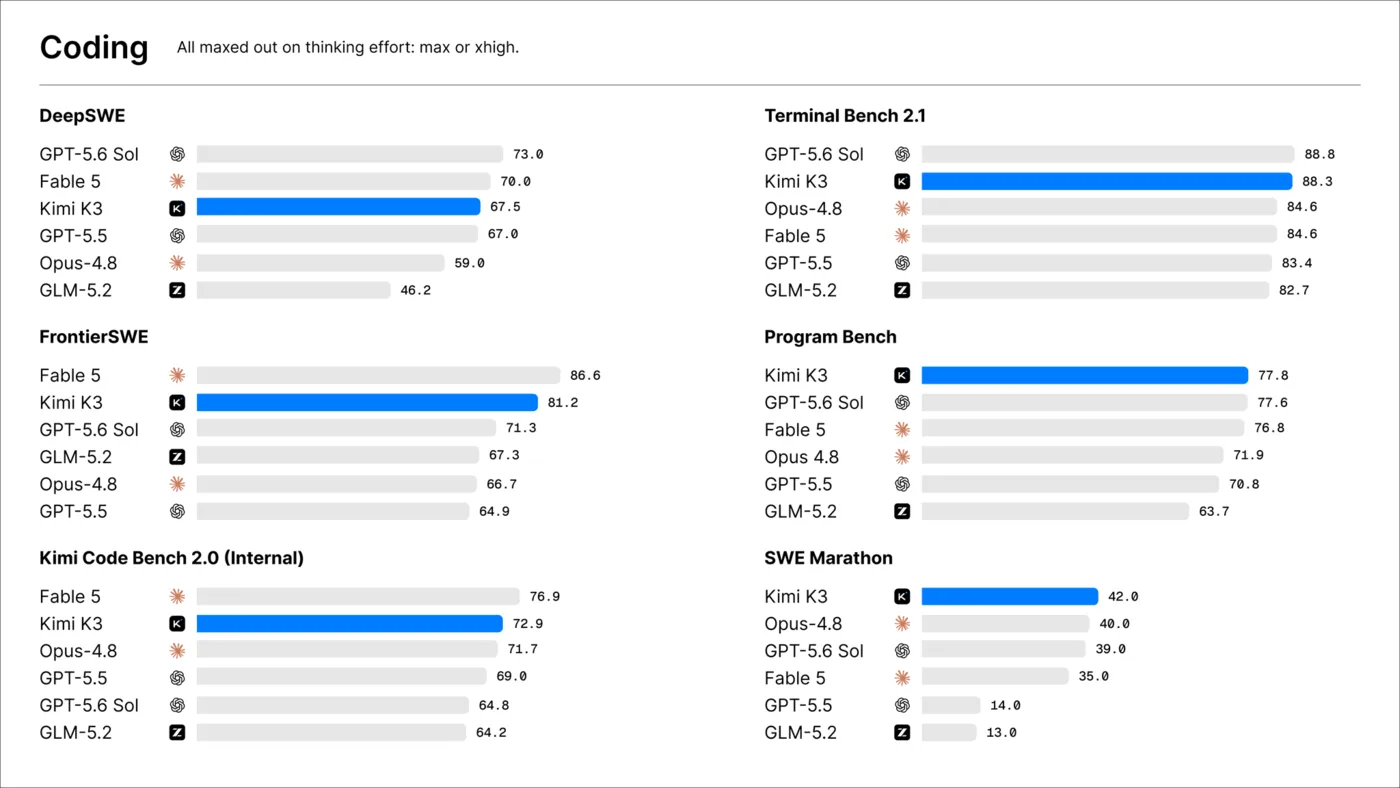
Source: Official K3 launch media / Kimi K3 blog, July 16, 2026; same class of charts the open-weight card points back to.
Kimi K3 license (what “open source” still restricts)
Hugging Face lists the license as other / kimi-k3, not a stock SPDX MIT. The Kimi K3 License on the repo is MIT-like with commercial gates. In plain language (always re-read the file—this is not legal advice):
| Situation | Rough reading |
|---|---|
| Research, fine-tunes, experiments | Generally allowed |
| Internal use (not offering the model/capability to third parties) | Carve-out—Sections 2–3 style commercial gates do not apply the same way |
| Embed K3 inside a product feature (not “rent the raw model as an API”) | Often treated differently from pure Model-as-a-Service—read the definitions carefully |
| You run Model as a Service (third parties control prompts / fine-tunes via your hosted K3) and your group’s revenue > $20M over any consecutive 12 months | You must negotiate a separate agreement with Moonshot before commercial use of that kind |
| Very large consumer products (>100M MAU or >$20M monthly revenue) | “Kimi K3” must be prominently displayed on the UI of that product/service |
| Access only through Moonshot official products or certified partners | Commercial gate carve-outs also apply |
Our take for builders: if you are a startup under the revenue bar shipping an app with K3 inside, this is closer to “open with brand + MaaS rules” than “Apache free-for-all.” If you plan to compete with Moonshot’s own API, budget a license conversation, not just bandwidth.
Prior Kimi open lines (K2.5 / K2.6 / K2.7 Code) trained people to say “Modified MIT.” K3 is its own document. Quote the file, not the tweet.
Who should download Kimi K3 weights (and who should not)
| You are… | Do this week | Skip |
|---|---|---|
| Indie / hobbyist who googled “kimi k3 free” or “open source” for chat | Use kimi.com or free-tier product paths (honest free options) | Multi-hundred-GB Hugging Face pull “just to try chat” |
| App / agent builder shipping features | API kimi-k3 + cost control | Self-host until unit economics force it |
| Infra / platform with multi-node GPUs | Verify HF files → vLLM / SGLang recipes → load test | Random community GGUF mirrors |
| Research lab needing weights for audit / fine-tune | Clone official repo, pin commit, read LICENSE | Trusting re-uploads with renamed folders |
| Team that lives in the IDE | Stay on K2.7 Code / Kimi Code for day-to-day PRs (which model) | Forcing full K3 for every autocomplete |
Selection judgment (ours, not Moonshot’s): open weights change the ownership and audit story. They do not change the product story for most readers. If your pain was “API bill” or “subscribe paused,” downloading 2.8T-class shards is a strange fix—capacity problems move from Moonshot’s GPUs to yours.
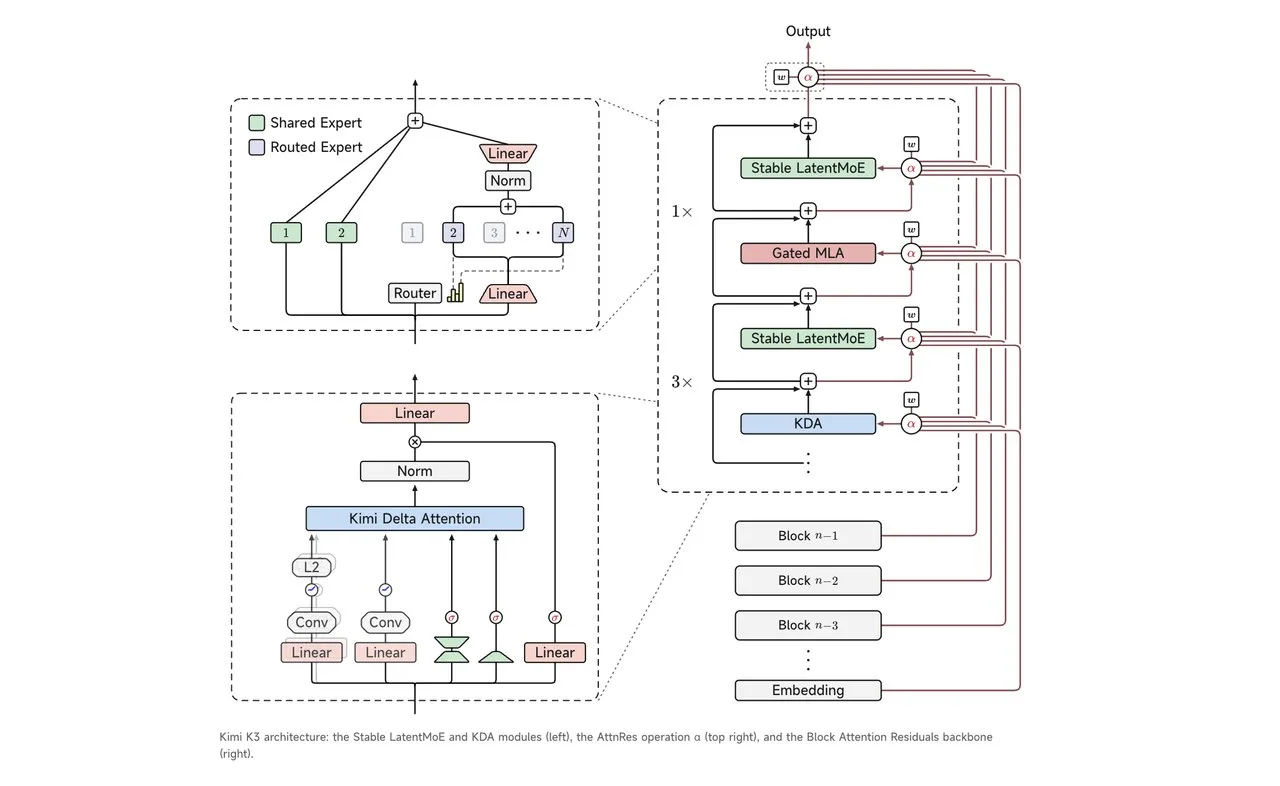
Source: Official K3 launch materials / Kimi K3 blog, July 16, 2026.
How to use the open weights without lying to yourself
Path A — Hosted (still the default)
- Chat / Work / Code on kimi.com
- API:
kimi-k3, OpenAI/Anthropic-compatible on platform.kimi.ai - Public list price we tracked earlier: roughly $0.30 cache-hit / $3 cache-miss / $15 output per 1M tokens—confirm on the live pricing page (pricing deep dive)
Thinking defaults to max effort and returns reasoning_content. That is great for hard jobs and expensive for casual chat—discipline beats slogan.
Path B — Self-host (now that Files are real)
The model card currently steers day-0 serving toward:
Checklist that still applies from our self-host guide:
- Confirm
moonshotai/Kimi-K3Files + LICENSE (not a fan mirror). - Pin engine version that claims K3 / KDA support.
- Plan multi-accelerator capacity—not a single consumer GPU.
- Load-test prefix cache / long context before you promise 1M tokens in prod.
- Keep a fallback to the hosted API when your cluster melts on day two.
Path C — “Open” for compliance / procurement
If legal asked “is there a downloadable weight artifact we can put in a VPC?”—yes, as of today. That is the procurement win. It does not auto-mean cheaper or better than the API for the first 90 days of ops.
Myths to kill on open-source day
| Myth | Reality |
|---|---|
| “Open source means free forever on my laptop” | Scale is datacenter-shaped; active params alone are ~104B-class |
| “License is plain MIT” | Kimi K3 License with MaaS + $20M and big-product attribution rules |
| “I must switch every workflow to self-host tonight” | Product/API quality is already live; weights unlock control, not magic IQ |
| “Any Hugging Face upload named Kimi-K3 is fine” | Prefer moonshotai + commit pin; community GGUF mirrors will explode—verify lineage |
| “Open weights fix the subscription pause” | Pause was about hosted capacity (background); your own GPUs are a different queue |
| “Download = free API forever” | Weights are for your infra; the hosted API still bills on platform.kimi.ai (pricing guide) |
What to do this week (decision tree)
If you only need answers or code help: open the app or API. Done.
If you need offline / VPC / fine-tune rights: start the official download, read LICENSE, book GPU time, follow vLLM/SGLang docs—not a random Discord zip.
If you sell inference: run the revenue test against Section 2 of the license before you put kimi-k3 on a price page.
If you write IDE agents all day: keep K2.7 Code as the default; route hard, long, multi-domain jobs to K3 (release switch guide).
Where next
- Hub with live specs: /kimi-k3
- Status / timeline: /kimi-k3-status
- Self-host depth: /blog/38-kimi-k3-self-host-vllm-day0
- API money discipline: /blog/37-kimi-k3-api-pricing-cost-control
- Family pick K2.6 / K2.7 / K3: /blog/29-kimi-which-model-k26-k27-k3
Bottom line: July 27 delivered what the launch post promised—frontier-scale open weights, not a consumer one-click install. Download if you have a reason; otherwise use the model the easy way and let someone else babysit the cluster.